Faculty of Arts and Science

About the Faculty of Arts and Science

Establishment of the Faculty of Arts and Science

Dean: Shunichi Maruno

The world of education is rapidly changing and developing with the ongoing internationalization of the education sector and globalization of society, accompanied by a dwindling population of 18-year olds due to the decreasing birth rate and the onset of an era in which all candidates will be able to successfully gain a place at university. These various developments have raised expectations and hopes from within Japan and overseas that universities will welcome student diversity and seek to reassess the needs for university education from new perspectives.

One of these expectations is for the creation of new knowledge through engaging in creative discussion on conceptualizing the differing views, concepts and values of people from different cultures as one theme or challenge. By doing so, it is hoped that skills relating to communication, self-expression, creative and critical thinking and collaboration and cooperation will be developed, all of which are essential for identifying issues and then going on to implement solutions.

A second expectation is that a response can be made to the need to gain diverse knowledge in areas that are not necessarily of a deeply specialized nature, but are nonetheless required to engage vigorously in an ever-changing knowledge-based society. For these, the most essential requisites are skills to appropriately gauge various situations and settings and have the intellectual inspiration and strength to respond in an adaptable manner, in addition to developing open-minded sensitivities that can identify the various meanings and value inherent in various social issues.

A third expectation is for the cultivation of “learning that finds joy in finding the answers to the unknown and the creation of attitudes focused on the joy of learning,” which should be at the very foundation of university education. This means engaging in learning that does not rely merely on the volume of knowledge, nor takes great bodies of documentation or knowledge on faith alone, but rather learning that seeks to consider issues with a deeply critical and reflective eye from multiple perspectives. In this way an insatiable spirit of challenge and bold attitudes can be developed that continually seek to open up new possibilities and find ways of solving problems and phenomena that were previously thought unsolvable.

What all of these hopes and expectations share in common is the desire to develop mindsets and attitudes inclined towards mature “active learning,” on both human and intellectual levels, which transcends the confines of each era or specific circumstances and promotes continuous, independent lifelong learning. It is a desire to see the “creation of benchmarks for morals and value judgments in intellectual, social and personal terms” that are an essential requirement for living in society, imbued with the expectation that strong, free-thinking and flexible human resources will be developed.

At Kyushu University, our educational objective has been the education of individuals capable of leadership in a diverse range of fields in Japan and willing to assume an active role in the world, and our Education Charter emphasizes principles of humanity, social responsibility, global citizenship and advancement of knowledge, and it is these principles that have informed education policy across the entire university. However, in response to the above-mentioned expectations and hopes of society from within Japan and around the world, in order to develop human resources who are capable of truly taking a leadership role in the globalizing international community that is beset by multiple challenges, it will be necessary to enhance the education we have provided to date in an even more structured, wide-ranging and quality-oriented manner. It was based on our belief that it was essential to restructure the education system so that it would provide a consistent and integrated structure from general education through to specialized education and then on to graduate education, that led to the establishment in October 2011—our centennial year—of the Faculty of Arts and Science, as we head into our next century.

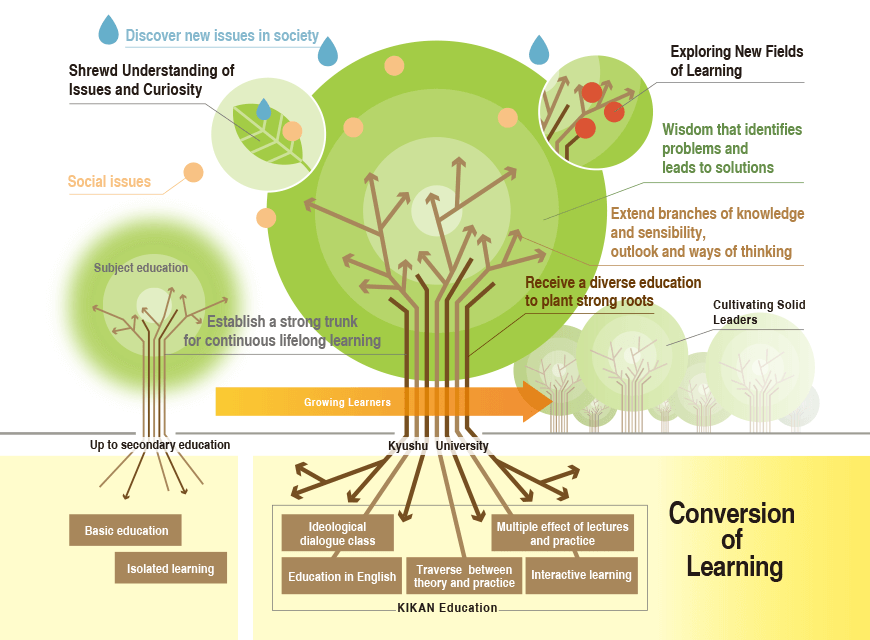
Efforts to cultivate mindsets and attitudes (basic elements) for “learning about learning” and “learning about ways of thinking” in the context of life-long, independent active learning (Students learning the following qualities).

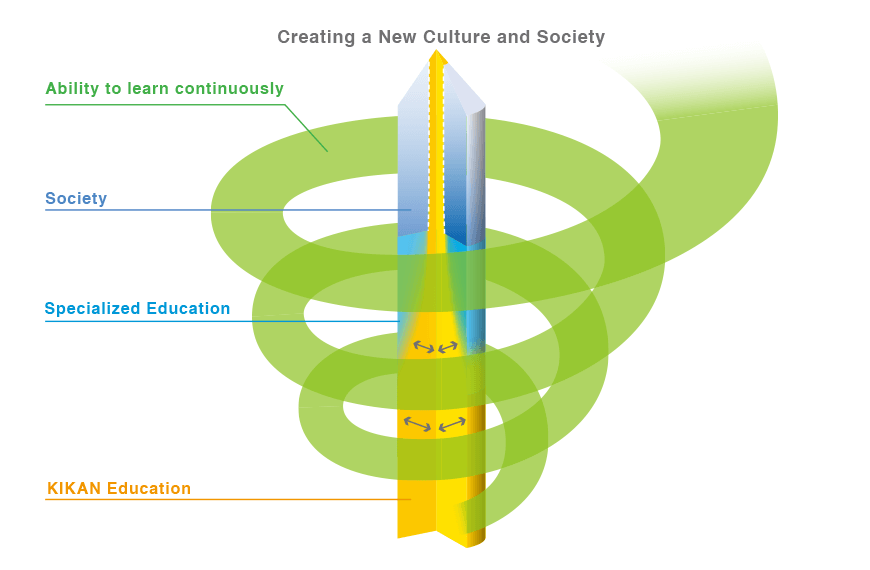
As can be seen from the diagram, the Faculty of Arts and Science seeks to create learning opportunities that will provide students with various options and experiences before going on to specialized education. The Faculty seeks to nurture broad knowledge and perspectives that will enable each and every student to determine their own educational framework based on their own decisions. In addition, the faculty engages in efforts to cultivate mindsets and attitudes (basic elements) for “learning about learning” and “learning about ways of thinking” in the context of life-long, independent active learning.

The important mission of basic learning is to implement diverse teaching methods for diverse fields of basic knowledge, based on a class structure that will enable students to realize knowledge exchange at the multidisciplinary level. The Faculty seeks to encourage students to learn or acquire the following: (1) a creative and critical spirit that will engender reflective thought, (2) flexible thought processes and attitudes, (3) broad perspectives and the skill to take in the bigger picture, (4) deep understanding of ethics and morals, (5) humility and rich sensitivity, and (6) deep understanding of humanity. If students are able to acquire mindsets and attitudes concerning basic concepts and studies, then in specialist and graduate education it can also be expected that they will then be able to go on to easily acquire advanced knowledge and skills based on the foundational conceptual framework they have acquired in basic learning. In that sense the basic education is an extremely important undertaking and represents a crucial period that will form the core of a student’s university education.

The organization that will be responsible for providing this basic learning is the Faculty of Arts and Science. The Faculty has been newly established based on a university-wide affirmation of the concept of President Arikawa that “foundational education is in itself important as enhancement of foundational education leads to enhancement of specialized and graduate education, and also to the creation of outstanding research. To that end it is necessary for outstanding teachers from all disciplines with a strong desire and passion for education who have highly developed research skills and have an excellent track record to actively participate in foundational education.”

In contrast to the former College of General Education, the teachers affiliated to the Faculty of Arts and Science are not exclusively engaged in the provision of basic education alone. Basic education will be implemented based on a cross-university structure, with the participation of teachers from all research institutions in the university. By implementing such a structure, from an early stage in their university education, it will be possible for students to come into contact with and learn from many teachers who possess broad-based knowledge, diverse experiences and unique ideas. However, although it is a fact that the proportion of teachers affiliated to the Faculty of Arts and Science who will engage in the teaching of basic education courses is larger than the proportion of teachers affiliated to other research institutions, where necessary these teachers are also responsible for graduate education. Furthermore they also perform an important managerial function, liaising closely with the various schools and faculties of the university concerning the composition of the curriculum and courses at the Faculty of Arts and Science, as a means of promoting a strong management structure for basic education based on a university-wide structure.

Based on the newly established Faculty of Arts and Science, which will function as a “body for continuous learning” that seeks to enhance and promote basic learning, from the new perspective of basic learning at the core of university education, with a high-minded spirit and strong sense of mission, Kyushu University will endeavor to advance basic learning and develop capable human resources who are able to take leadership roles in a variety of fields in Japan and overseas.

Members

the executives

Division for Specialized Programs

Division for Arts and Science

Division for Admission

Division for Student Counseling and Guidance

Division for Technical Support

  • Nobutaka Ohsugi
  • Hideyuki Imasaka
  • Aya Sato
  • Haruka Sakai
  • Norihide Shikada
  • Toshiro Yoshida (G30 staff)

Access

Ito Campus

Center Zone, Ito Campus
744, Motooka, Nishi-ku, Fukuoka 819-0395
TEL: +81-92-802-5921 FAX: +81-92-802-5990

more

Campus Map

more
  • About
  • Members
  • Access