
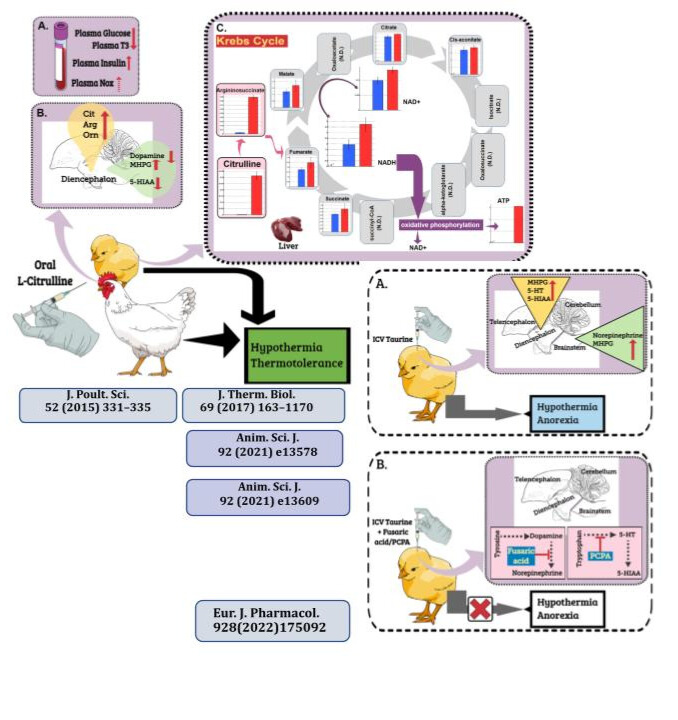
With global warming, heat stress is becoming a pressing concern worldwide. In chickens, heat stress reduces food intake and growth and increases body temperature and stress responses. Although it is believed that young chicks do not experience heat stress as they need a higher ambient temperature to survive, our series of studies in young chicks showed that they are sensitive to heat stress. We have also revealed some amino acids, namely L-citrulline (L-Cit; Chowdhury et al., 2017, 2021), L-leucine (L-Leu; Han et al., 2017, 2018, 2020), and taurine (Elhussainy et al., 2021, 2022, 2023) have hypothermic role and afford thermotolerance.
Amino acid metabolism is severely affected by heat stress. For example, prolonged heat stress reduces plasma L-Cit in chicks and L-Leu in the brain and liver of embryos. L-Cit and L-Leu supplementation affords thermotolerance in young chicks (Chowdhury et al., 2017; Han et al., 2018). NPY expression is increased in the brains of heat-exposed chicks (Ito et al., 2015). Intracerebroventricular (ICV) injection of NPY increased plasma taurine (Eltahan et al., 2017) and ICV injection of taurine induced hypothermia through monoaminergic regulation (Elhussiany et al., 2022). We are further interested molecular mechanisms of L-Cit, L-Leu and taurine in energy metabolism and the development of brain thermoregulatory circuits.