
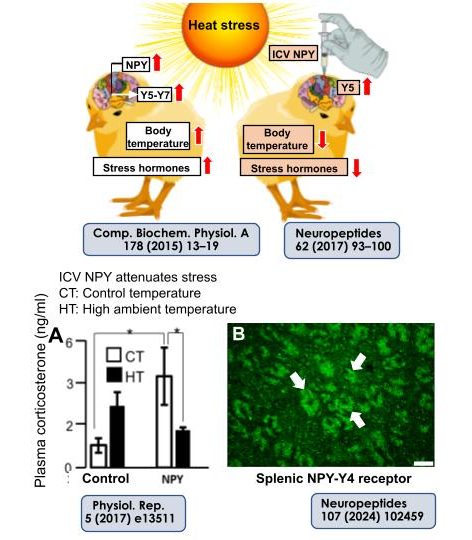
Brain neuropeptides are involved in regulation of various physiological functions including food intake, stress response, thermoregulation, etc. Previously, we found that the brain neuropeptide Y (NPY) mRNA expressions were increased in chicks under heat stress (Ito et al., 2015). Central injection of NPY caused to reduce physiological stress (Bahry et al., 2017) and attenuated cellular heat stress response in the spleen (Nishimura et al., 2022) in heat-exposed chicks. Recently, we have reported that NPY-Y4 receptor expression was increased in the spleen in response to high ambient temperature in male chicks (Nishimura et al., 2024). These results suggest that NPY is a hormone that reduces the stress response under heat stress.
Previous studies have also reported that NPY is involved in regulating humoral immunity, and that the Y4 receptor also binds to peptide YY (PYY) and pancreatic polypeptide (PP), which are NPY family peptides (Larhammar et al., 1993; Larsen and Kristensen, 1997). Based on these findings, we conceived the possibility that NPY and its family of peptides may be involved in the control of immune function under heat stress. Therefore, we are interested to elucidate the physiological action of NPY family peptides in immune organs and their molecular mechanisms.