AboutLaboratory Identity
This page introduces the elements that constitute the visual identity of the laboratory, along with the concepts embedded within them. Just as the laboratory’s name, research focus, and modes of communication have evolved, its visual expression has also been gradually refined. In the 2026 renewal, we returned to our origins by restoring the mascot character, while updating the overall design to reflect the laboratory’s current direction, Future Brain Science.
Logo
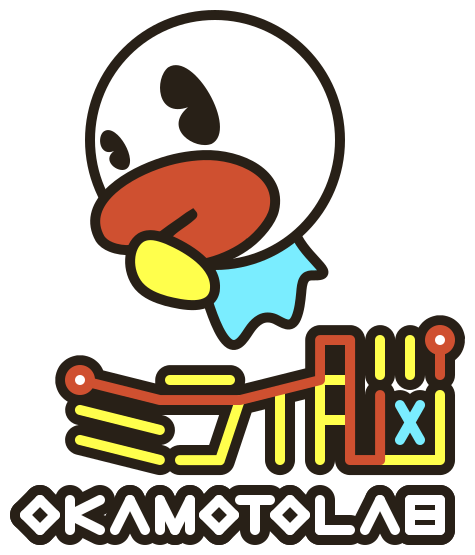
The logo integrates the mascot character and the wordmark into a single figure, expressing the laboratory’s research philosophy and stance as one coherent image. The horizontal version serves as the primary logo, while the vertical version is used in mobile contexts and layouts that require a vertical arrangement.
Mascot Character
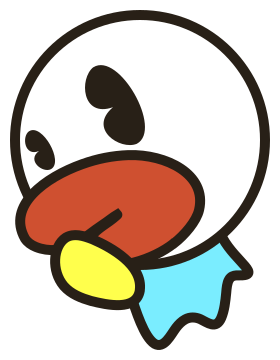
The laboratory’s mascot character, Noutama, represents a neuroscientist in the making. Its mouth is abstracted from the shape of a brain, and the hand placed upon it represents “measurement,” a foundational practice in neuroscience. Its forward-looking gaze reflects intellectual curiosity and analytical rigor. In the 2026 renewal, its appearance was updated to convey a stronger sense of future orientation, in line with the laboratory’s focus on Future Brain Science.
Noutama embodies two core commitments of the laboratory: generating new research “seeds” and cultivating the next generation of researchers. During a period when the laboratory adopted a more explicitly brain-centered branding strategy, the character was temporarily set aside in order to foreground the research domain itself. As the laboratory’s conceptual framework has since become more integrated, it has been reintroduced as a symbolic link between the laboratory’s origins and its present direction.
Wordmark
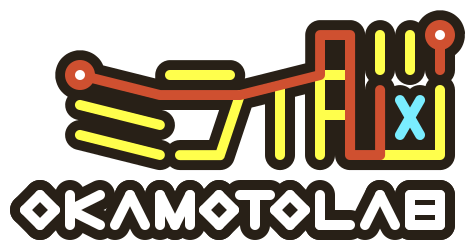
The wordmark is constructed entirely from lines, combining MIRAI (in katakana), NOU (the kanji for “brain”), and OKAMOTOLAB (in the Latin alphabet) into a single continuous structure.
Language composition
MIRAI is written in katakana to acknowledge that Future Design originated in Japan. MIRAI-NOU remains in Japanese to indicate that the bridging research domain—Future Brain Science— originated in this laboratory in Japan. The laboratory name OKAMOTOLAB is written in the Latin alphabet to express international openness and global communication.
Connected lines and colors
A continuous red line runs from the upper-left stroke of the “MI” in MIRAI toward the middle of NOU, expressing continuity and collaboration across research activities. The red color symbolizes will and driving force.
This red line is also drawn in a waveform that evokes brain activity, alluding to neuroscience as the laboratory’s foundational discipline. At the same time, the connected letterforms from MIRAI to NOU may resemble a maze-like structure. It represents advancing toward the scientific frontier with firm intention, even while navigating uncertainty.
The intersecting light-blue lines inside NOU express the future-oriented stance central to Future Design. The visual “jump” from the blue lines back to the red stroke embodies the method of Future Design itself: thinking from the future and acting in the present, structurally embedded within the logo.
Borderless OKAMOTOLAB
OKAMOTOLAB is rendered as a single connected form without spaces, with white cutouts integrated into the strokes. This expresses a borderless stance: crossing disciplinary boundaries, enabling collaboration beyond differences in background, gender, nationality, or origin, and remaining attentive to accessibility and inclusion for those who face various forms of barriers.
Usage Policy
The logo serves as the representative mark of the laboratory (e.g., the top page and other major entry points). The wordmark functions as a compact expression of our philosophy and methodology (e.g., in headings, signatures, and slide titles). The mascot character communicates approachability and a commitment to mentorship (e.g., in outreach materials and introductory contexts). By selecting the appropriate element for each situation, we maintain coherence while preserving the core identity of the laboratory.
First published: 12 September 2014.
Full-body mascot character version added: 9 February 2015.
Wordmark updated: 9 August 2015.
Major redesign: 20 March 2023.
Logo revised: 28 July 2023.
Major redesign: 23 February 2026.
Last updated: April 25, 2026.
